Valuable insights into Wildfire Mitigation in Colorado, written by Terry Stoka :
Dear Friends, I have copied a couple of articles that I wrote for my monthly newspaper submission dealing with fire mitigation. The spring is stacking up to be so dry and crispy and hot that fire danger might be at an all-time high. It is the responsibility of all of us to work on our properties to make them as fire resistant as possible and reasonable.
Here are the articles. -Terry Stoka
================================
Mitigation The time is now.
In the first half of 2025 we enjoyed greater than normal snow and rain that made the grass grow tall and colored the trees a deep green. Then in mid-summer the sky slammed shut and the rest of the year was very dry. This winter has been unusually warm and dry with days in the 60s and nights above freezing. So far at my house, we have had only 18 inches of snow, less than half of the average of 37 inches for the end of January. The warm weather compounds things in that it sucks that moisture out of the ground faster than normal.
The weather forecasters have predicted a drier spring than normal because of the El Nina weather phenomenon that affects the eastern Pacific Ocean. That is not good news.
A dry spring means two main things more beetles and greater fire danger. If the trees dont get enough moisture, they produce less sap and that allows the pine beetles to bore into the trees and lay eggs in greater numbers. Many of those trees that are attacked will die and become a fire hazard. The greater fire danger reminds us of the spring of 2013. That June we had received less than half of the normal precipitation. The temperature on the day of the fire was 97 degrees, the second record day in a row. The humidity was 4% and when the wind picked up to 42 mph in the afternoon, the fire that had somehow started (my speculation is arson) took off and didnt stop for three days. Two people died, 488 homes were destroyed and 14,000 acres of forest were torched. It will take more than a generation to restore those areas to their former beauty.
Mitigation is a word we hear a lot but few people take it to heart. Mitigation is forest management where trees are thinned, dead trees are removed and dead branches are removed. Most of the timbered area of Black Forest has too many trees on each lot. Foresters tell us that a properly thinned forest has trees where the branches don't touch the branches of adjoining trees. I will confess that my lot is too dense. That means they must compete for the available water. The larger trees need much more water and when they cant get it they produce less sap and open the door for a beetle invasion. When you see a cluster of trees that are turning light green or orange you can be sure the beetles have attacked that cluster of trees.
Not very many people are comfortable with a chain saw and dont have the time, energy or know-how to tackle major mitigation on their lot. Simply cutting a fading tree doesnt solve the problem because the tree remains moist inside long enough for the beetles to mature and fly to the next tree. On my lot I cut the tree into firewood lengths and split the wood so it can dry and kill the beetles before they mature. The slash can be hauled to the slash/mulch site where it will be ground into mulch and kill any remaining beetles.
For those not comfortable with a chainsaw, an alternate mitigation method is using a lopper. The lower branches of a pine tree often die as the tree grows taller and those branches are a great danger for a ladder fire. In a ladder fire, the fire moves along the ground consuming the pine needles and sometimes gets high enough to ignite the lower, dead branches on trees. That fire then moves upward like a ladder into the higher branches where the dry needles are found and the entire tree will be quickly engulfed. By lopping the dead and even some green branches up to about 6 feet off the ground, you can prevent a ladder fire. If the trees are widely separated a ladder fire wouldnt spread to other trees so the lower branches could be saved if they are green. Smaller trees can be saved this way.
When a fire occurs in high winds, the flames jump from treetop to treetop in what is known as a crown fire. Crown fires are impossible to stop unless the wind dies down or a large open space prevents the embers from flying to the next tree. We had a crown fire in 2013.
Mitigation doesn't mean getting rid of all of the pine needles. Decaying pine needles are the main fertilizer for our ponderosa pines. The also insulate the ground from sun heat and help to hold the moisture. Just concentrate on getting pine needles at least 5 feet from your house.
Lets get serious about mitigation and clean up our lots to prevent fire from again devastating our beautiful forest. At a minimum, get a lopper and lop off the branches that could lead to a ladder fire. Don't let a ground fire rise up to the top of the trees. If we all work together, we can greatly reduce the possibility of a forest fire this summer.
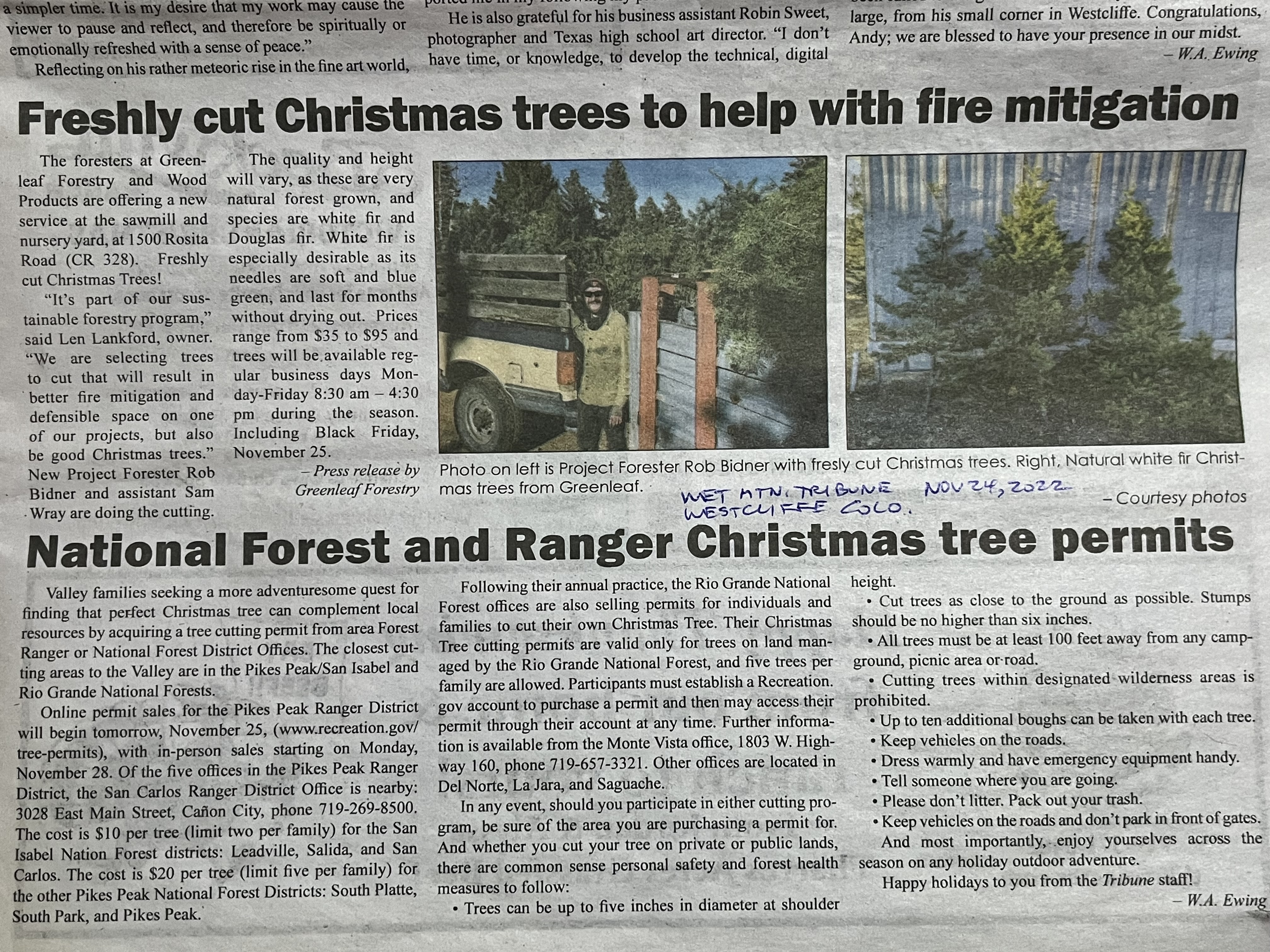
Freshly cut Christmas trees to help with fire mitigation: Wet Mountain Tribune, November 24 2022. Article can be found here.
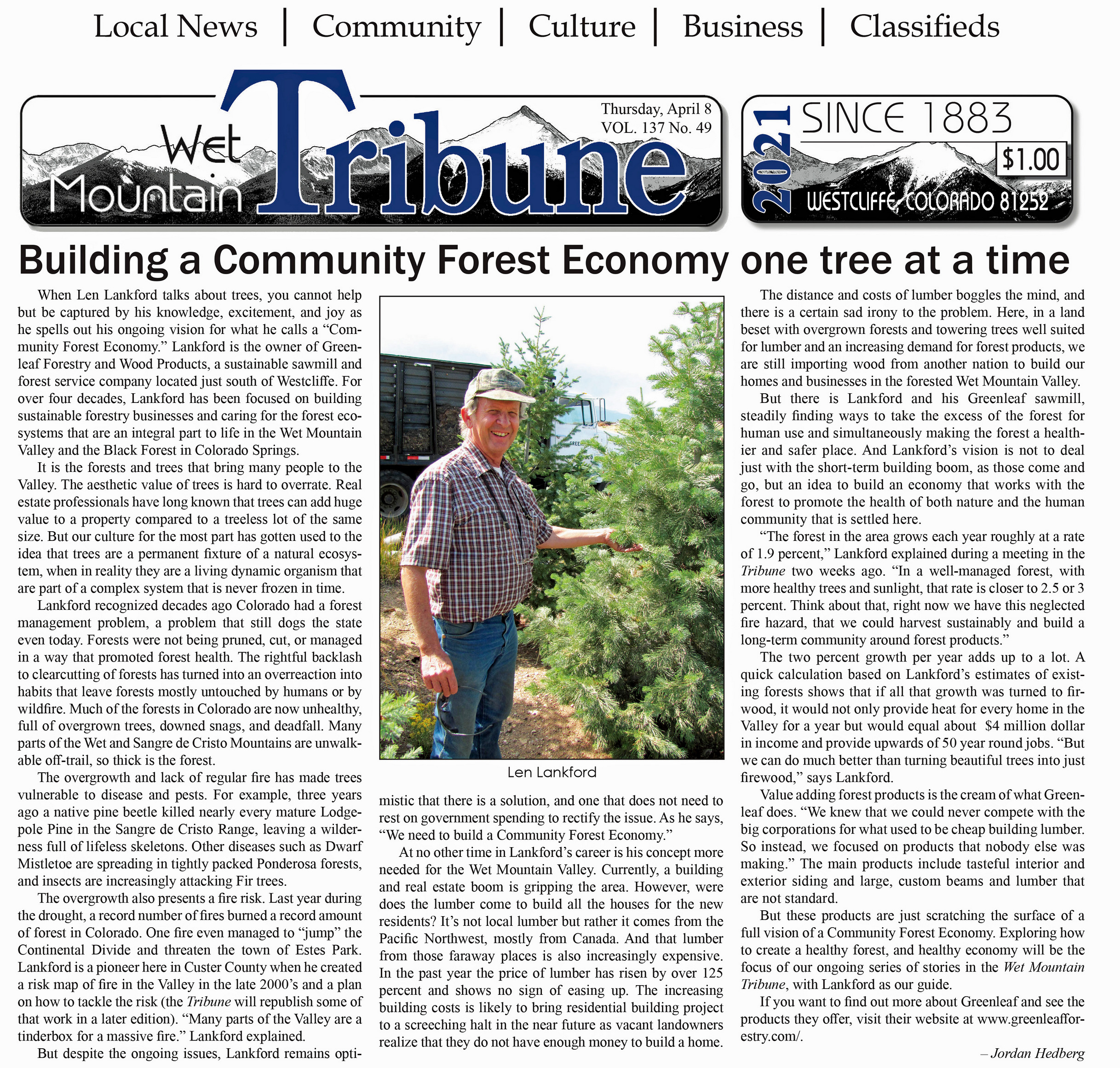
Building a Community Forest Economy one tree at a time: Wet Mountain Tribune, April 8 2021. Article can be found here.
Community Wildfire Plan: The Custer County Community Wildfire Protection Plan was developed with our owner, Len Lankford. The 60 page document is full of photos and ideas for the county. It can potentially serve as the foundation document for a new project, The Forest Stewardship Master Plan for the Sangres Click here to read the summary.
The Night the Trees Died: A stand-replacing wind event happened on November 13, 2011 in the Sangre de Cristo Mountains. Thousands of acres were affected with sometimes 50-100 trees per acre down. Article can be found here.
Windstorm Hits Sangres: November 13 2011 Hundreds of acres have windthrown trees. Article can be found here.